

Poland scrambled NATO fighter jets to protect its airspace during the May 24 attack. European leaders have spent the past eighteen months warning that a Russian attack on a NATO or EU member is possible within five years.
Hold the North | World
By Kate Griffith
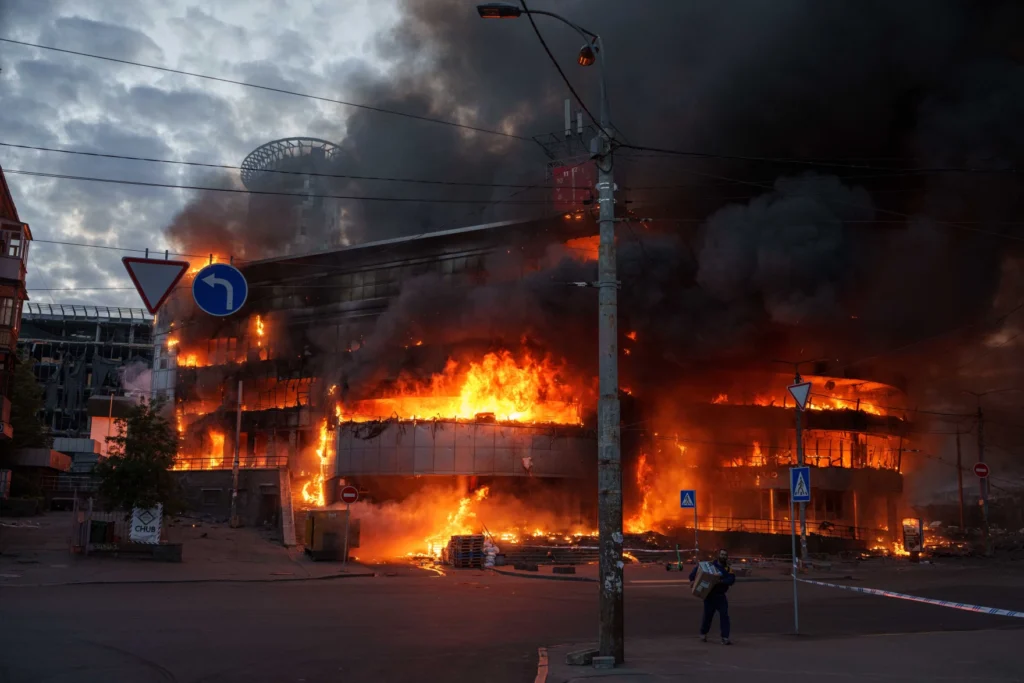
Russia launched what Ukrainian officials are describing as one of the heaviest aerial bombardments of Kyiv since the start of the four-year war on the night of May 23 into the early hours of May 24, 2026. According to the Ukrainian Air Force, Russia launched 90 missiles and approximately 600 attack drones against multiple targets across Ukraine. Among the missiles was a Russian Oreshnik — an intermediate-range, nuclear-capable hypersonic ballistic missile, used for only the third time since Russia began its full-scale invasion in February 2022.
President Volodymyr Zelenskyy confirmed the use of the Oreshnik on Sunday in a post on Telegram. He said the missile struck Bila Tserkva, a city of approximately 200,000 people located about 40 miles from the outskirts of Kyiv. The Russian Defence Ministry also confirmed the use of the weapon.
By Sunday afternoon, Ukrainian officials reported at least four people killed and more than 80 injured. Kyiv Mayor Vitalii Klitschko reported that a five-storey residential building in the Shevchenko district was struck and burned, and that a school building was damaged while people were sheltering inside. The National Chornobyl Museum was heavily damaged. Windows were blown out at Ukraine’s Foreign Ministry. Damage was also reported in the Kyiv region, in Cherkasy, in Kropyvnytskyi, and in Khmelnytskyi Oblast.
The weapon
The Oreshnik, which means “hazelnut tree” in Russian, is an intermediate-range ballistic missile with a range of several thousand kilometres, capable of carrying nuclear or conventional warheads. Russian President Vladimir Putin has publicly stated that the missile travels at 10 times the speed of sound, is capable of destroying underground bunkers, and is, in his characterization, immune to existing missile defence systems. Putin has further stated that several such missiles, even with conventional warheads, could deliver damage comparable to a nuclear strike.
The Oreshnik was used for the first time against the Ukrainian city of Dnipro in November 2024, and a second time against the Lviv region in January 2026. Sunday’s strike on Bila Tserkva marks the third recorded use of the weapon.
Russian framing and the Starobilsk claim
The Russian Defence Ministry has stated that the attack was a response to Ukrainian strikes on Russian civilian targets and has asserted that its own missiles were aimed at Ukrainian military facilities. The Russian Defence Ministry has denied targeting civilians.
In the days before the May 24 attack, Russia announced that Ukraine had struck a college dormitory in Russian-occupied Starobilsk in eastern Ukraine, killing 18 people. The Kremlin warned that Ukraine would face “inevitable and severe punishment.” Ukrainian officials have not claimed responsibility for the Starobilsk strike. Independent verification of the circumstances in Starobilsk remains contested.
The Polish response
During the overnight attack, the Polish Air Force scrambled Polish and allied fighter jets to protect Polish airspace. The scramble was reported by Polish state media and confirmed by Polish defence officials. It was the latest in a series of similar scrambles by NATO members along the Ukrainian border in the past year.
Poland is a member of NATO. Article 5 of the North Atlantic Treaty obligates each member to treat an armed attack against any other member as an attack against all members.
The European warnings
Senior European defence and political officials have issued a sequence of public warnings over the past eighteen months about the prospect of a direct Russian attack on a NATO or European Union member state.
On December 11, 2025, NATO Secretary General Mark Rutte said in a public address that Russia could attack a NATO country within the next five years and that Europe must be prepared for the scale of war comparable to that endured by previous generations.
On February 16, 2026, Germany’s Chief of Defence General Carsten Breuer and the United Kingdom’s Chief of Defence Staff Air Marshal Sir Richard Knighton issued a joint public statement calling on European nations to confront, in their phrasing, uncomfortable truths about security and to make hard choices about defence spending.
EU foreign policy chief Kaja Kallas has stated publicly that Russia could challenge the bloc’s defence readiness within three to five years and that European defence budgets must be increased accordingly. The European Commission has launched a defence plan known as Readiness 2030, aimed at making the EU fully capable of defending itself against an external attack by the end of the decade.
Polish Prime Minister Donald Tusk has stated that Europe should be prepared for a possible major conflict with Russia by 2027, citing his conversations with NATO Supreme Commander Alexus Grynkewich. German Defence Minister Boris Pistorius has named 2029 as a possible window for direct Russian aggression against NATO territory.
The two mutual defence treaties
Two distinct mutual defence obligations are relevant to the current situation.
Article 5 of the North Atlantic Treaty, signed in 1949, states that an armed attack against one or more NATO members shall be considered an attack against them all, and obligates each member to take such action as it deems necessary, including the use of armed force, to restore and maintain security. Article 5 has been formally invoked once in NATO’s history — by the United States, following the September 11, 2001 attacks. Canada is a NATO member.
Article 42.7 of the Treaty on European Union, in effect since the Lisbon Treaty was ratified in 2009, states that if an EU member state is the victim of armed aggression on its territory, the other member states have an obligation of aid and assistance by all the means in their power. Article 42.7 has been formally invoked once — by France, following the November 2015 Paris attacks. Canada is not an EU member.
Ukraine is not a member of either NATO or the European Union. Ukraine has applied for EU membership and has been granted candidate status, but full accession requires unanimous agreement of all existing EU member states and has not been granted.
Zelenskyy’s position
In remarks following the May 24 attack, Zelenskyy reiterated his demand for accelerated EU accession for Ukraine. He has stated previously that associate or candidate status, without full membership, leaves Ukraine in what he has characterized as a grey zone vulnerable to continued Russian aggression. He has stated that Ukraine’s defence should be a treaty obligation of European partners rather than dependent on bilateral aid.
Zelenskyy also stated on May 24 that the attack should not be allowed to remain without consequences for Russia, and called for decisions from the United States, Europe, and other partners.
The United States position
U.S. President Donald Trump told the Daily Telegraph in an interview published April 1, 2026, that he was strongly considering pulling the United States out of NATO after allies failed to back his military action against Iran. He described NATO as a “paper tiger” and said withdrawing the United States from the defence pact was, in his words, “beyond reconsideration.”
Trump has not formally initiated U.S. withdrawal from NATO. Multiple analysts and former officials, including former Italian ambassador to NATO Stefano Stefanini, have stated publicly that the U.S. president’s statements have already eroded the credibility of the alliance’s deterrent function regardless of whether formal withdrawal occurs.
The Canadian position
Canada is a signatory to the North Atlantic Treaty and is therefore bound by Article 5. At the NATO summit in The Hague in June 2025, Prime Minister Mark Carney committed Canada to a target of 5% of GDP in defence spending by 2035, which the Parliamentary Budget Office has estimated at approximately $159 billion per year by 2035-36.
The Canadian Armed Forces Regular Force currently stands at approximately 65,700 personnel against an authorized target of 71,500. The Parliamentary Budget Office has documented a shortfall of approximately $18.5 billion in budgeted defence capital spending over the fiscal years 2017/18 to 2023/24.
The 2025 federal budget presented defence spending as lump-sum projections over five years, with no annual breakdown. The C.D. Howe Institute has stated that, despite the spending commitments in that budget, Canada is not on track to reach the NATO target of 3.5 percent of GDP in core defence spending by 2035.
The Canadian government has not publicly addressed how the Canadian Armed Forces would respond to an invocation of Article 5 in the near term.
Sources: Reuters, Associated Press, NBC News, NPR, CNBC, Euronews, The Kyiv Independent, The Washington Post, Modern Diplomacy, BBC News, AFP, Yahoo News / Reuters Brussels summit coverage, Atlantic Council, Euromaidan Press. Public statements by Volodymyr Zelenskyy, Vladimir Putin, Mark Rutte, Kaja Kallas, Donald Tusk, Carsten Breuer, Sir Richard Knighton, Boris Pistorius, Stefano Stefanini, Vitalii Klitschko, Donald Trump, and Mark Carney cited as on the public record. Canadian defence figures from the Parliamentary Budget Office and the C.D. Howe Institute.